
The Friendship Audit Nobody Wants to Do (But Everyone Needs)
A warm, honest guide to examining your friendships with intention. Exploring reciprocity, energy drain, and the difference between a friendship that needs tending and one that's simply run its course, with insights from leading friendship researchers and authors.
FRIENDSHIPS
Fernanda
3/29/20267 min read


Let's be honest: "friendship audit" sounds kind of clinical, doesn't it? Like you're about to sit down with a spreadsheet and grade your people. That's not what this is.
But here's the truth I keep coming back to: most of us will spend more time reviewing our monthly subscriptions than we spend thinking intentionally about our friendships. And yet our friendships shape so much of who we are, how we feel, and whether we feel seen in this world.
So yeah, this is the post nobody wants to read. But I think you need it. (I need it too, trust me.)
Why It Feels So Uncomfortable
There's something that feels almost wrong about examining our friendships with any kind of critical eye. Like, these are people we love! People who've shown up for us, seen us through hard seasons, watched us cry in parking lots.
But here's the thing, caring about someone and being drained by the friendship are not mutually exclusive. Both can be true at the same time. And pretending otherwise is how we end up exhausted, resentful, and quietly wondering why we feel so lonely even though our calendar is technically full.
The friendship audit isn't about deciding who's a bad person. It's about getting honest about what's actually happening so you can show up better for the relationships that deserve your energy.
Friendships Don't Maintain Themselves, That's Not a Flaw
One of the most freeing things I've ever read came from Shasta Nelson's book Friendships Don't Just Happen! (it's right there in the title). We've been fed this idea that real friendships just... flow. Effortlessly. That if you have to work at it, something must be wrong. That's a myth, and it's actually kind of harmful.
Nelson's work centers on what she calls "frientimacy": the intimacy we build in friendship through positivity, consistency, and vulnerability. None of those three things happen by accident. They require intention. And when one of them goes missing for long enough, the friendship starts to feel hollow, even if nobody did anything wrong.
So before you write off a friendship as "over," it's worth asking: has it just been neglected? Has life gotten loud and busy and the two of you stopped being consistent with each other? Sometimes the friendship isn't broken. It's just been sitting in the corner collecting dust, waiting for someone to reach out first. That's not a sign to let it go. It might be a sign to show up.
Not All Friendships Are Meant to Be the Same (and That's a Good Thing)
Here's something that honestly changed how I think about my whole social world: the idea that friendship isn't one-size-fits-all (and it was never supposed to be).
Evolutionary psychologist Robin Dunbar spent years researching how humans actually organize their social lives, and what he found is that our friendships exist in rings of connection: intimate layers that move outward from your very closest people to your wider community. Think of it like concentric circles. At the very center: your 1-2 most intimate people. Then a layer of close friends, maybe 5 or so. Then good friends, around 15. Then your wider social circle of acquaintances, up to about 150.
And here's the part that really gets me: people drift from one ring to another over time. Someone who was in your innermost circle five years ago might be in a wider ring today. Someone you just met could be moving inward fast. That's not failure. That's just how friendship actually works.
Kat Vellos, author and friendship researcher at We Should Get Together, takes this even further. She challenges the whole concept of the "best friend" label, pointing out that "best" is a squishy barometer. The criteria can change at any time. Who you talk to the most, who you feel emotionally closest to, who has been there the longest ... those aren't always the same person. And that's okay.
What this means for your audit: you don't have to hold every friendship to the same standard. The friend you call at 2am is not the same as the friend you grab brunch with once a quarter. Both of those friendships have value. The question isn't "is this person my best friend?" The question is: do I know which circle they're in, and am I treating that friendship accordingly?
Sometimes what feels like an energy drain is actually just a misalignment of expectations. You're wanting a 2am friend from someone who's really a quarterly brunch friend, and no one told you that was even a category.
The Reciprocity Check
That said, there's a difference between a friendship that needs tending and one that only ever flows in one direction.
Reciprocity doesn't mean keeping score. It doesn't mean you split every check or rotate who texts first. Life is messy and seasons change. Sometimes you're the one carrying more, and sometimes you're the one being carried. But there's a difference between seasons and patterns.
Ask yourself:
When something big happens in my life, is this person one of the first ones I call?
Do I leave conversations feeling full, or do I walk away feeling a little emptier?
Have I been the one reaching out… most of the time… for a while now?
Dr. Marisa Franco, psychologist and author of Platonic, talks about how our attachment style: whether we're secure, anxious, or avoidant, shapes what's working and what's failing in our friendships. Sometimes what looks like a one-sided friendship is actually two people with avoidant tendencies both waiting for the other to reach out. And sometimes, it's genuinely just one person doing all the heavy lifting.
Only you can tell the difference. But getting honest about which one it is? That's where the audit starts.
The Energy Drain Conversation Nobody's Having
I used to think energy drain was just about toxic friendships: the dramatic ones, the ones full of conflict and chaos. And yes, those count. But some of the most draining friendships I've had were with people who weren't doing anything wrong at all.
Sometimes it's a values drift. You've both grown, just in different directions. Sometimes it's a dynamic that worked really well in one season of your life and that season is now behind you. Sometimes it's simply that the connection is one-sided in a way that's so subtle you almost missed it: until you're sitting in your car after brunch and you realize… you never actually talked about anything going on with you.
Energy drain shows up quietly. You find yourself making excuses not to hang out. You feel a vague sense of obligation rather than genuine excitement. You put your phone face-down when their name pops up.
None of that makes you a bad friend. It might just mean this friendship needs a real, honest look.
Run Its Course vs. Needs Tending; How Do You Know?
This is the part I find the most nuanced, and honestly the most important.
Not every friendship that's struggling has run its course. Shasta Nelson encourages us to evaluate our friendships based on the connection we actually have. Not the one we hope to have. That's such an important distinction. Because a lot of us are holding onto an old version of a friendship: the version from five years ago, the version that felt easy. And we're grieving its absence while still showing up out of habit.
Signs a friendship might just need tending:
There was something that happened (or didn't happen) that you've never actually talked about
Life got busy and you both drifted, but when you do connect, it still feels warm and real
The care is genuinely there, it's just been neglected
Signs a friendship may have run its course:
You've grown into people who don't actually have much in common anymore, and that's okay
The relationship only functions in one direction, and it's been that way for a long time
Every interaction leaves you feeling worse, not better (even when nothing "bad" happened)
You're staying out of guilt, history, or fear of hurting them, not because the friendship is actually feeding you
Here's what I want you to hold: letting a friendship fade is not the same as being a bad person. Dr. Franco reminds us in Platonic that our culture often puts romantic relationships on a pedestal while treating friendship as secondary: something that should be "easy" and shouldn't require effort. That same bias makes us feel guilty for outgrowing a friendship, as if doing so makes us disloyal. It doesn't. And as Dunbar's research shows us, people come and go in and out of each other's rings of connection. And the most important thing is that we treat each other the best we can while we're here. Sometimes the most loving thing you can do (for both of you) is to release the pressure of maintaining something that's simply run its natural course.
So… What Do You Actually Do With This?
You don't have to send anyone a breakup text. (Please don't.) The friendship audit isn't about dramatic exits. It's about clarity.
It might look like deciding to invest more intentional energy into the friendships that are already reciprocal and life-giving. It might look like having an honest conversation with someone you've drifted from: the kind that starts with "I miss us." It might look like quietly releasing the guilt you've been carrying about a friendship that quietly faded out months ago.
And sometimes, it just looks like making room. When you're less tangled up in relationships that aren't really working, you have more space (emotionally, energetically) for the connections that actually light you up.
That's what Filled Cups is all about, after all. Not more connections. Better ones.
A Few Questions to Sit With
If you want to do a gentle version of this for yourself, here are the questions I'd start with:
Who do I feel genuinely excited to see (not obligated)?
Who makes me feel like myself when I'm with them?
Is there a friendship I've been avoiding that I haven't been honest about why?
Where am I pouring the most energy, and is it being matched, even partially?
Who have I been taking for granted that deserves more of my attention?
Am I expecting a "quarterly brunch friend" to show up like a "2am friend", and is that fair to either of us?
You deserve friendships that feel like home. The kind where you show up and your whole nervous system goes ah, yes ... this. Those friendships exist. But sometimes you have to do the quiet, a little uncomfortable work of making space for them.
I'm proud of you for even reading this far. That means something.
Loved this post? These are some of my favorite resources on adult friendship: Shasta Nelson's Friendships Don't Just Happen!, Dr. Marisa Franco's Platonic, Robin Dunbar's Friends, and Kat Vellos's book We Should Get Together. (I may earn a small commission if you purchase via these links)
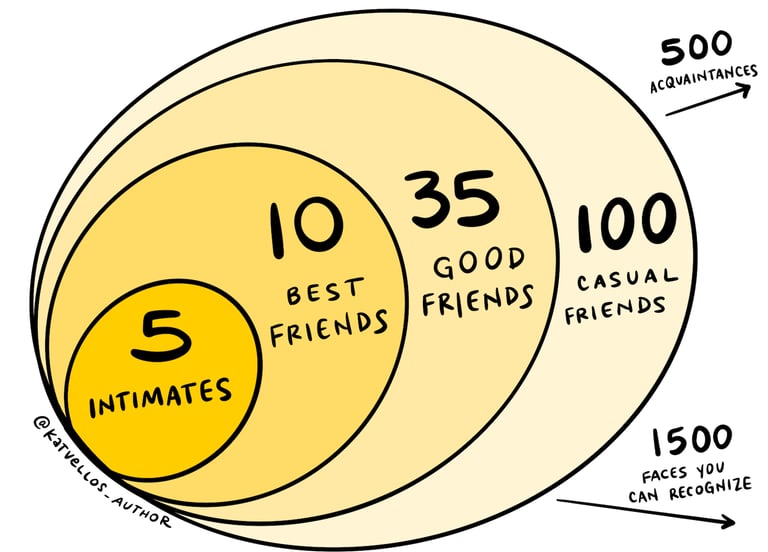
The Rings of Connection theory was first posited by evolutionary psychologist and connection hero Robin Dunbar, illustrated here by Kat Vellos
Connecting individuals through meaningful relationships and valuable resources.
connect
Newsletter
Subscribe to our newsletter for valuable insights and event news.
© 2026. Filled Cups. All Rights Reserved.
INSPIRATION